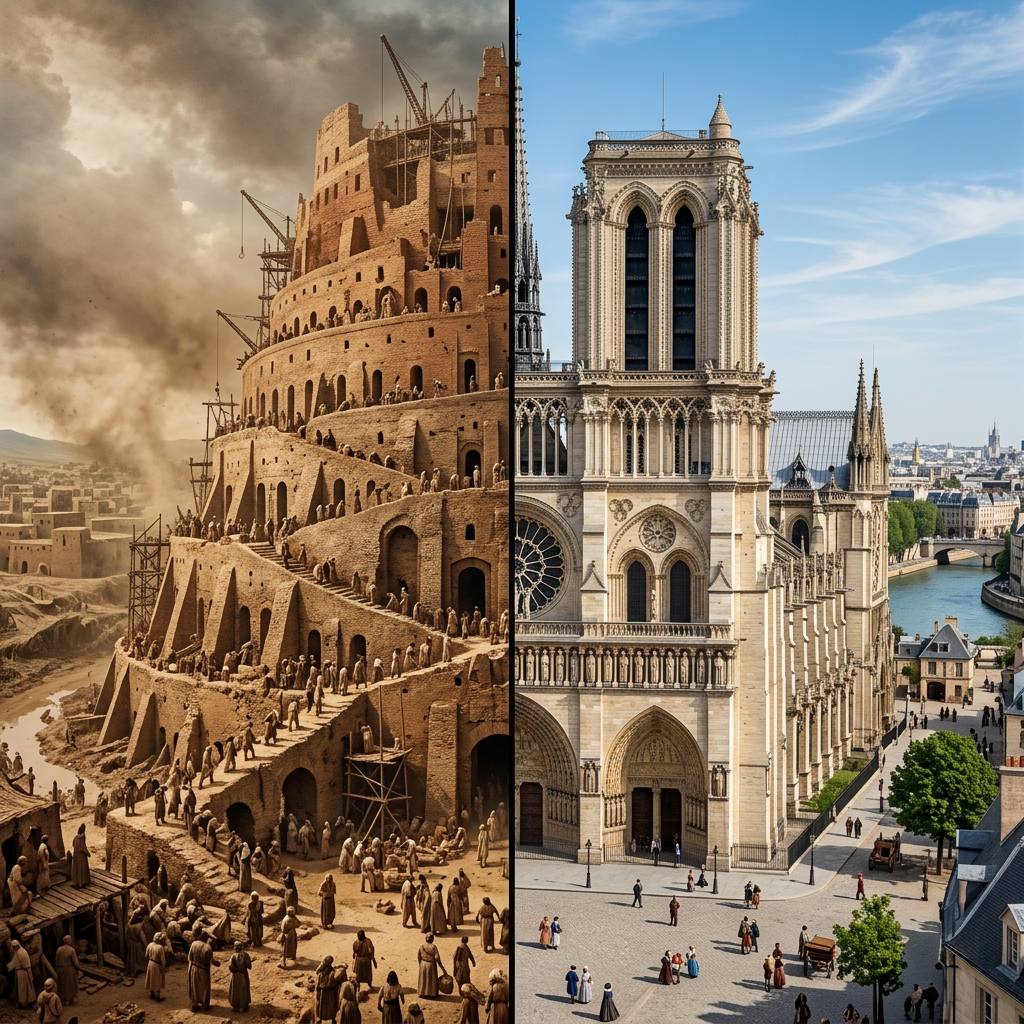
Two weeks ago, the Vatican published the most interesting AI ethics document of the year — and almost nobody in tech noticed.
Pope Leo XIV’s first encyclical, Magnifica Humanitas, is 42,000 words long, heavy on scripture, and absolutely worth your time. At minimum, read the first few paragraphs yourself. Then send the rest to your Claude and ask it to digest the thing properly — not a 5-bullet summary, but a real reading. It’ll take more than a minute. That’s the point.
The encyclical is built around a deceptively simple metaphor, and once you see it, you can’t unsee it.
Two construction projects. The Tower of Babel: top-down, hyper-organized, relentlessly efficient, built on the logic that the individual is worth exactly as much as she contributes to the whole. And the rebuilding of Jerusalem’s walls under Nehemiah: bottom-up, community-driven, every family assigned a section of wall near their own house — prayerful, distributed, human in scale. Nehemiah doesn’t impose a plan from above. He listens, he organizes, he gives people ownership of their piece.
The Church’s argument is that we are, right now, choosing which of these we build with AI.
This isn’t the first time someone made this exact distinction. In 1999, Eric S. Raymond published The Cathedral and the Bazaar — an essay about open source software that turned out to be about much more. The cathedral: software built behind closed doors by a small priesthood, released perfect and complete. The bazaar: Linux, Apache, the whole messy distributed miracle of strangers collaborating in public. Raymond’s argument was that the bazaar produced better software, but the deeper point was about what kind of human agency each model assumed. The cathedral treats contributors as a liability to be managed. The bazaar treats them as the point.
Raymond was writing about code. Leo is writing about civilization. But they’re describing the same fork in the road.
What’s striking is how non-abstract the framing actually is. Leo isn’t talking about souls or salvation — he’s talking about labor markets, agency, and what happens when decisions migrate out of human hands at scale. He writes that “the pursuit of greater profits cannot justify choices that systematically sacrifice jobs.” Blunt, for a papal document. And correct.
I’ll admit I came to this expecting theological hedging and left with something sharper than most think-pieces I’ve read this year. There’s a clarity here that the tech industry rarely produces about itself: the question isn’t whether AI is powerful, it’s whether the people building it understand the difference between a cog and a contributor.
One more thing worth noting: Leo XIV is the first American pope. The timing feels deliberate in a way I can’t quite articulate. Whatever you make of the institution, having this ethical position stated this clearly, from this platform, in this moment — it matters.
The document is dense. It will reward patience. Read the opening. Send the rest to your AI. Then sit with the Babel/Jerusalem distinction for a while.
It’s a better frame than most of what Silicon Valley is offering.
Magnifica Humanitas, Encyclical Letter of His Holiness Leo XIV, May 15, 2026


Leave a Reply