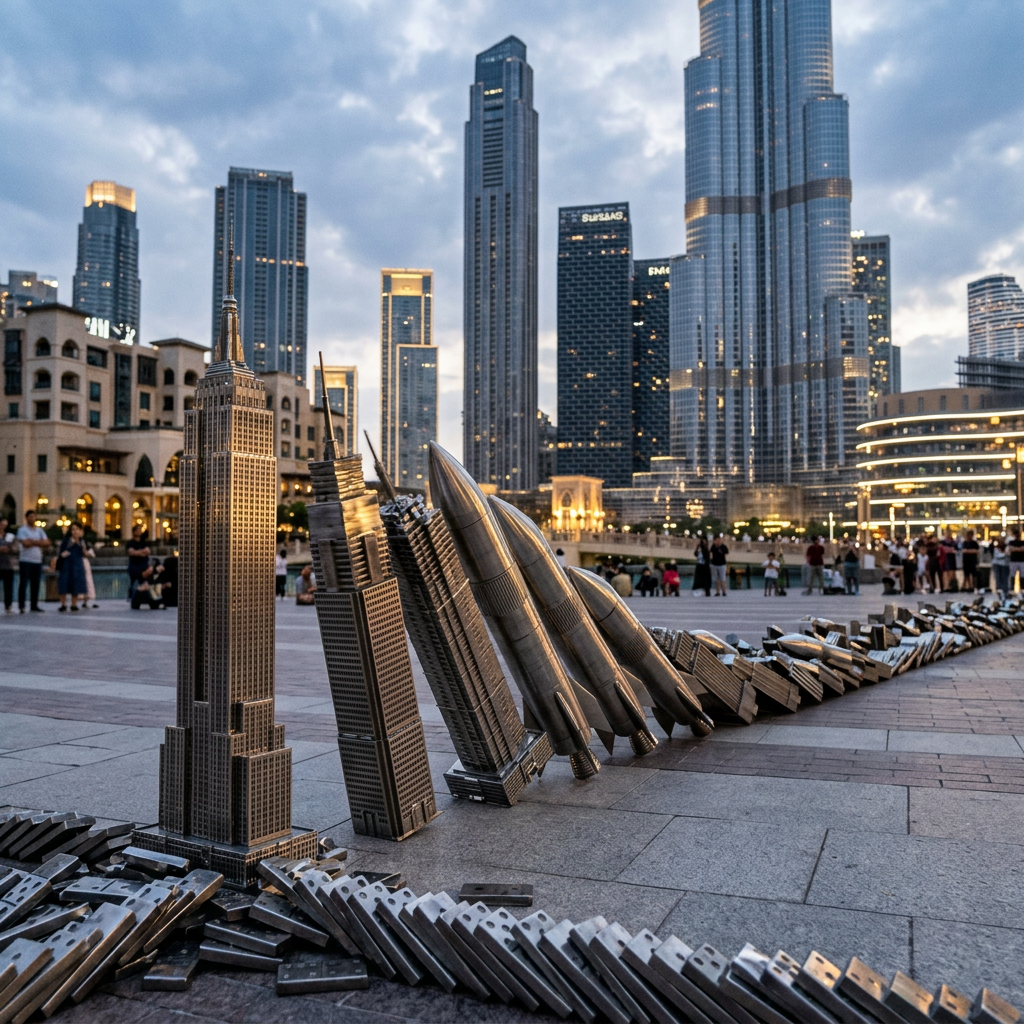
The SpaceX IPO Series — Part 3 of 4
In Part 2, we tracked $440 billion in market damage that occurred while SpaceX was raising $75 billion. In Part 3, we explain why that ratio exists, what it means for IPO buyers, and why the damage may not be finished.
Why Small Withdrawals Cause Massive Damage
The numbers from Part 2 raise an obvious question: how does $5 billion in withdrawals cause $440 billion in market losses?
The answer is that financial markets are not a simple store of value. They are a confidence system. Prices don’t represent a fixed amount of money sitting somewhere — they represent what the last buyer and seller agreed to pay, multiplied by every unit in existence. When large investors start selling, several things happen simultaneously, each amplifying the last.
First, prices fall. When prices fall, algorithms that manage risk automatically trigger sell orders — not because anyone decided to sell, but because the rules say to. Second, retail investors see the price falling and follow. Third, traders who borrowed money to buy assets — using leverage — get forced to sell immediately if prices drop past a threshold, because their lender demands the money back. This forced selling hits the market at exactly the wrong moment, accelerating the decline. On June 4 alone, $1.8 billion in forced liquidations cascaded through crypto derivatives markets in a single session.
The result is a cascade: a relatively small amount of deliberate selling triggers an avalanche of automatic, reactive, and panicked selling by people who never intended to sell at all.
This is why $4–5 billion in institutional outflows from Bitcoin ETFs corresponded to $440 billion in total crypto market value lost. The ratio isn’t constant — it depends on how leveraged the market is, how much automated selling is set up, and how fragile sentiment is at the time. In mid-2026, all three conditions were unfavorable. The market was primed.
Who Actually Pays
The institutional investors who sold to fund their SpaceX allocation largely got out near the top. They made a deliberate decision, moved early, and received reasonable prices for what they sold. This is how sophisticated capital operates.
The people who paid are everyone who was still holding when the cascade hit.
A retirement saver in the US whose Bitcoin ETF dropped 22% between mid-May and early June. A tech investor in Europe watching Palantir bleed 30% for reasons they can’t identify in any news about the company. A young person in Asia who has been steadily saving in Ethereum for three years, who logged in last week to find a third of their balance gone. None of these people chose to fund SpaceX. None of them were asked. The cost simply arrived.
This is the structural reality of a fully invested world. When a $75 billion drain opens in global markets, the water doesn’t flow evenly from everyone — it flows fastest from the most volatile assets, which are disproportionately held by retail investors seeking higher returns precisely because they can’t afford the lower-risk alternatives.
Elon Musk owns 42% of SpaceX. At $1.75 trillion, his stake is worth approximately $735 billion. That number crystallizes on June 12. The diffuse, invisible cost that funded the conditions making it possible was paid by millions of people whose individual losses will never make a headline.
The Third Wave: It Hasn’t Hit Yet
There is a third layer of damage that hasn’t happened yet — and it concerns the people buying SpaceX shares at $135.
As of June 5, SpaceX’s IPO is already oversubscribed: $150 billion in orders for $75 billion worth of shares. The offering will clear without difficulty. The question is what happens after June 12.
Morningstar, the independent research firm, values SpaceX at $78 per share — 42% below the $135 IPO price. They describe it as “significantly overvalued” in almost any near-term scenario and recommend that investors wait for a better entry point after the IPO. This isn’t fringe analysis — it’s the sober output of a discounted cash flow model applied to SpaceX’s actual financials.
If the stock drifts from $135 toward analyst consensus — not a crash, just a return to fair value — the math for IPO buyers is brutal. With 555.6 million shares, every $10 the stock falls costs IPO buyers $5.5 billion. A drift to Morningstar’s $78 target would cost those buyers $31.7 billion.
What makes this trajectory more likely, not less, is the lockup structure. Company insiders are restricted from selling immediately — but the restrictions lift in stages. At 70, 90, 105, 120, and 135 days after IPO, insiders can sell 7% of their holdings at each interval. The 180-day full lockup expires in early December 2026. Each of these dates is a supply event. Each one puts downward pressure on the price at exactly the moment retail investors who bought at $135 are hoping for a recovery.
The complete sequence of damage, if it unfolds as the structure allows:
- $440+ billion lost from global markets while institutions raised the cash
- $75 billion paid by IPO buyers for shares priced at more than double fair value
- Up to $31.7 billion more in losses as the stock corrects and insiders sell through December
Three waves. Three groups of people paying. One event.
A Question Worth Sitting With
Before Part 4, it’s worth pausing on the obvious framing we’ve built across these three pieces.
SpaceX is the villain. Musk is the beneficiary. The mechanism is extractive. The damage is real and quantifiable. All of that is true, and we’ve mapped it carefully.
But Part 4 asks a harder question: what if this isn’t really about SpaceX at all?
What if the $440 billion that evaporated from crypto and AI stocks wasn’t destroyed by an IPO — but was always going to evaporate, because it was never real in the first place? What if the true story here isn’t about one company, or one man, but about fifteen years of printed money that the global economy still hasn’t fully digested?
And if that’s true — if this kind of violent capital rotation is simply how excess liquidity eventually finds its way out — then the question isn’t whether SpaceX caused the damage.
The question is whether SpaceX is just the drain.
Continue to Part 4: The Drain →


Leave a Reply